How to Repair Cracks in a Concrete Driveway or Patio (Phoenix Homeowner Guide)
Step-by-step guide to repairing cracks in a concrete driveway, patio or pool deck in Phoenix: how to read the crack, clean and rout it, add backer rod, seal it with a flexible sealant, patch chips, cure in the heat and fix drainage, with the rule behind every step.
By Gabriel · Licensed Phoenix, Arizona General Contractor ROC 367058 (R-62) · 2026-11-03
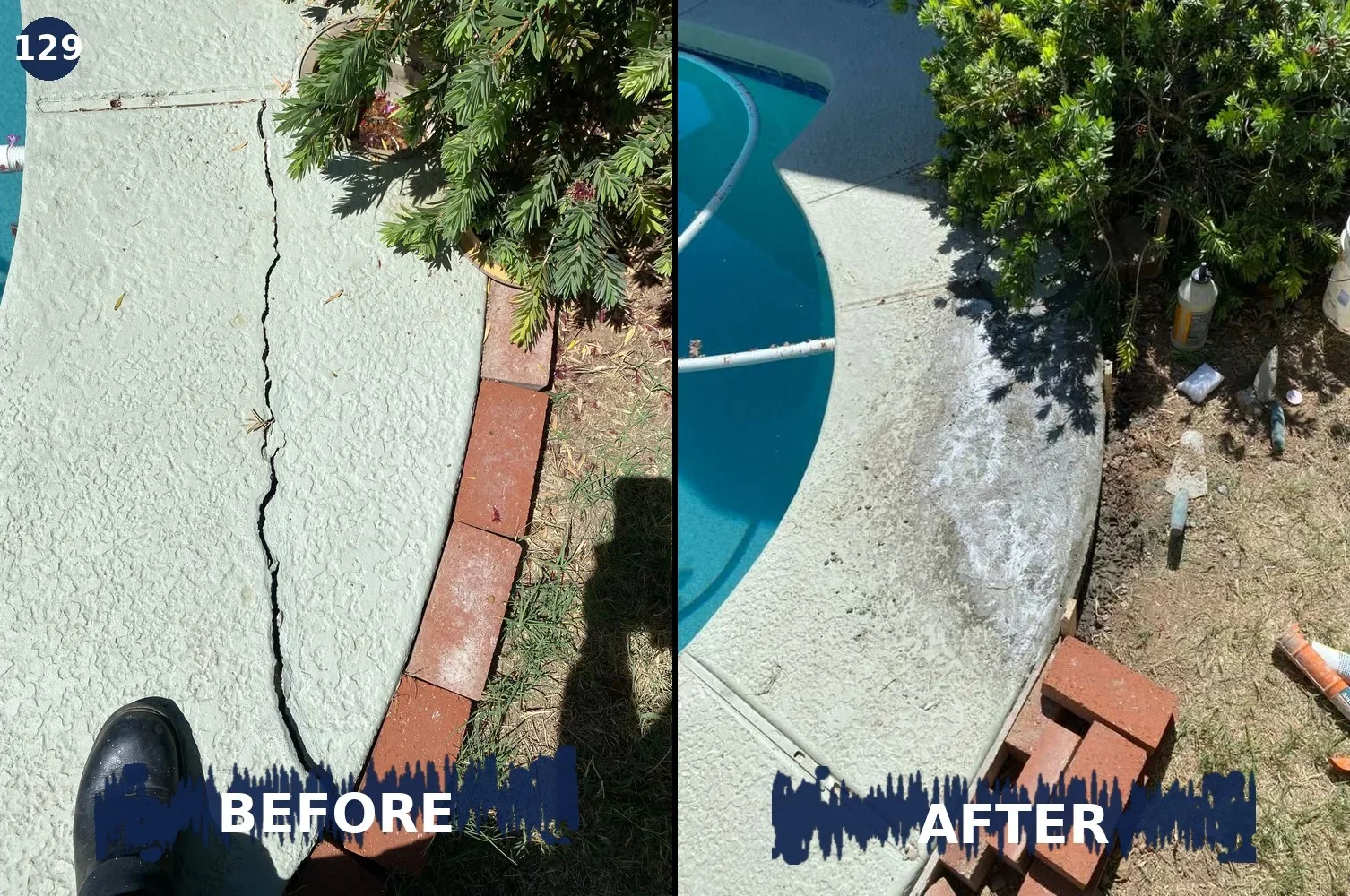
Almost every concrete driveway, patio and pool deck cracks sooner or later. Concrete shrinks as it dries, it moves with heat and cold, and the soil under it can shift. A crack by itself is not always a failure, but an open crack lets water, dirt and weed seeds in, and in Phoenix the monsoon storms push a lot of water across a slab in a short time. Sealing the crack the right way keeps a small problem small.
The most common mistake I see is filling a crack with plain concrete or mortar. It looks fine for a while, then cracks again right next to the patch, because the slab still moves. Below is the order I follow when I repair cracks in a driveway or patio. Every step says why it matters and which rule or guide is behind it: the 2024 International Residential Code (IRC), the American Concrete Institute crack-repair guide ACI 224.1R-07, the hot-weather guide ACI 305R-20, the OSHA silica rule for grinding and cutting concrete, and the technical data sheets of the products I name as examples. For more on how heat and storms affect a house, see my guide to monsoon and heat home repairs in Phoenix.
Tools and parts
- Respirator (N95 minimum, half-face P100 better), safety glasses, hearing protection, nitrile gloves and knee pads
- Angle grinder with a diamond crack-chasing or tuckpoint blade and a dust shroud connected to a vacuum (or a water-fed tool)
- HEPA shop vacuum, stiff wire brush, cold chisel, hammer and a spray bottle or garden hose
- Closed-cell backer rod sized a little wider than the crack, or bond-breaker tape, and a blunt tool to push it in
- Flexible polyurethane joint sealant that meets ASTM C920: self-leveling for flat slabs, non-sag (gun grade) for slopes and steps
- Caulking gun, putty knife, painter's tape and a tooling spoon
- Polymer-modified concrete patch (for example a vinyl concrete patcher) for chipped or pitted spots, a margin trowel and a steel finishing trowel
- Plastic sheeting and tape for curing, a tape measure, a pencil or crayon and a phone camera for monitoring
Step-by-step
Read the crack before you fix it
Measure how wide the crack is, check whether one side is higher than the other (a trip edge), and note where it runs: across the middle of a panel, along a joint, from a corner, or toward the house. Hairline shrinkage cracks that are not growing are cosmetic. A crack that opens and closes with the seasons is 'active' and needs a flexible repair. A crack with a raised edge, sinking panels, or cracks that continue into the house slab or stem wall point to soil or structural movement.
Why: The ACI crack-repair guide warns that unless the cause of cracking is corrected, new cracks will probably form near the original one. When the movement cannot be stopped, it says to rout and seal the crack, treating it as a joint. Knowing whether the crack moves decides whether you seal it with a flexible sealant or call a pro to deal with the cause.
Code: ACI 224.1R-07 Section 3.2 (unless the cause is corrected, new cracks will probably form near the original crack) · ACI 224.1R-07 Section 3.3 (routing and sealing treats a crack as a joint)
Check permits and who owns the concrete
Sealing and patching cracks in your own driveway or patio is maintenance. Tearing out and replacing a section, changing slopes, or pouring new concrete next to the house is a bigger job. The sidewalk along the street and the driveway apron at the curb are usually in the public right-of-way, which the city controls. If any of the cracked concrete is in that area, or you are in an HOA, call before you cut anything.
Why: The model 2024 IRC lists sidewalks and driveways among the work exempt from a building permit, but it also says an exemption does not authorize work that violates the code. Phoenix does not use IRC Section R105; it writes its own administrative rules, and work in the street right-of-way is a separate city matter. Checking first avoids having to redo work.
Code: Model 2024 IRC R105.2 item 5 (sidewalks and driveways exempt from building permit; exemption does not authorize code violations) · Phoenix amendment: IRC R105 reserved (Phoenix administrative code governs permits)
Pick a cool, dry time to work
Plan the repair for a dry day in the cooler months, or early morning in summer, with the slab in shade if possible. Concrete sitting in direct Phoenix sun gets much hotter than the air, so put your hand on it: if it is hot to the touch, wait. Do not seal right before a monsoon storm is forecast, because the sealant needs dry joint walls and time to skin over.
Why: Sealants and patches have temperature limits. The Sikaflex Self-Leveling Sealant data sheet, used here as an example, lists 40 to 100 F for both the air and the concrete, and Sika's data sheet recommends installing in extreme summer conditions while temperatures are falling, to avoid bubbling. The Quikrete Vinyl Concrete Patcher data sheet requires temperatures above 40 F for 24 hours. ACI's hot-weather guide explains that heat, low humidity and wind speed up drying and hurt fresh cement work.
Code: Sikaflex Self-Leveling Sealant product data sheet (air and substrate 40 to 100 F) · Quikrete Vinyl Concrete Patcher No. 1133 data sheet (above 40 F for 24 hours) · ACI 305R-20 Chapter 1 (high temperature, low humidity and wind accelerate moisture loss)
Clean out the crack without dry sweeping
Pull weeds and roots out of the crack, scrape out old sealant, dirt and loose concrete with a wire brush, chisel or screwdriver, and pry up any flaking edges. Mist the dust and pick it up with a HEPA vacuum instead of sweeping it or blowing it out with an air hose. Let the crack dry completely before sealing.
Why: Sealant only works if it sticks to sound, clean, dry concrete; the sealant data sheet requires joint walls that are sound, clean, dry and free of oil, grease and old residues. The OSHA silica rule that contractors work under does not allow dry sweeping or using compressed air to clean silica dust where safer methods are feasible.
Code: Sikaflex Self-Leveling Sealant product data sheet (joint walls sound, clean, dry, free of oil and residues) · OSHA 29 CFR 1926.1153(f)(1) (no dry sweeping or dry brushing of silica dust) · OSHA 29 CFR 1926.1153(f)(2) (no compressed air to clean silica dust)
Rout narrow cracks into a clean groove
Sealant cannot get into a jagged hairline crack. Run a crack-chasing diamond blade along the crack to cut a clean, straight-walled groove about 1/4 inch wide and at least 1/4 inch deep, following the crack. Use a grinder with a dust shroud and vacuum, or a water-fed tool, outdoors. Vacuum the groove again when you are done.
Why: ACI's crack-repair guide describes routing and sealing as cutting a vertical-walled groove, typically 1/4 to 1 inch deep, then cleaning and drying it and filling it with sealant. It notes the method is simple compared with epoxy injection and works best on flat horizontal surfaces like pavements. OSHA's Table 1 lists the dust controls for handheld grinders: an integrated water feed (outdoors) or a shroud with a dust collector.
Code: ACI 224.1R-07 Section 3.3 (routing and sealing: vertical-walled groove about 1/4 to 1 in. deep, cleaned and dried) · OSHA 29 CFR 1926.1153 Table 1, item (xii) (handheld grinders: water feed or shroud with dust collection)
Push in backer rod so the sealant only sticks to the sides
For cracks deeper than about 1/2 inch, push closed-cell backer rod (slightly wider than the groove) into the crack with a blunt tool so the sealant will be about half as deep as it is wide. For shallow grooves, lay bond-breaker tape in the bottom. Do not puncture the rod.
Why: If sealant bonds to the bottom as well as both sides, it cannot stretch and it tears when the slab moves. ACI's guide says active cracks need a bond breaker at the base of the routed channel and a channel with a width-to-depth ratio of usually 2 or more. The sealant data sheet calls for a 2-to-1 width-to-depth design, bond-breaker tape or closed-cell backer rod, and a sealant depth between 1/4 and 1/2 inch.
Code: ACI 224.1R-07 Section 3.3 (bond breaker at base of channel for active cracks; width-to-depth ratio usually 2 or more) · Sikaflex Self-Leveling Sealant product data sheet (2:1 width to depth; 1/4 to 1/2 in. depth; backer rod or bond-breaker tape)
Seal the crack with a flexible ASTM C920 sealant
Tape the edges if you want a neat line. On flat driveways and patios, pour a self-leveling polyurethane sealant into the groove in one direction and let it level itself, slightly below the surface so tires do not pull it out. On sloped surfaces, steps and vertical faces, use a non-sag gun-grade sealant and tool it smooth. Sprinkle a little clean sand on the wet surface if you want it to blend in. Keep cars off it until it cures.
Why: A flexible sealant stretches when the slab moves; cement-based fillers do not. ACI's guide lists epoxies, urethanes, silicones and similar sealants for routed cracks and says cement grouts should be avoided because they are likely to crack. ASTM C920 is the standard specification for elastomeric joint sealants, and the example sealant meets ASTM C920 Type S, Grade P, Class 25. Its data sheet says it is not for sloped surfaces, is tack-free in 1 to 2 hours and fully cures in 3 to 5 days.
Code: ACI 224.1R-07 Section 3.3 (urethanes, silicones and similar sealants; avoid cement grouts) · ASTM C920 (elastomeric joint sealants) · Sikaflex Self-Leveling Sealant product data sheet (ASTM C920 Type S, Grade P, Class 25; not for sloped surfaces; 3 to 5 day cure)
Patch chipped or pitted spots, not moving cracks
Shallow chips, pop-outs and pitted spots (as opposed to a moving crack) can be patched. Chip off all loose concrete, roughen smooth spots, clean and rinse. Dampen the area, remove standing water, then force a polymer-modified patch into the spot with heavy trowel pressure, overfill slightly and smooth it to match. Keep each patch small; large worn areas need a resurfacer or a replacement.
Why: Patch mixes are rigid, so they belong in holes and chips, not in cracks that move. The Quikrete Vinyl Concrete Patcher data sheet, as an example, says to remove unsound concrete, dampen the surface without standing water, and not to use it in cracks narrower than 1/8 inch or in expansion or control joints. It is meant for areas under 2 square feet and can be feathered to 1/16 inch.
Code: Quikrete Vinyl Concrete Patcher No. 1133 data sheet (surface prep; not for cracks under 1/8 in. or control/expansion joints; areas under 2 sq ft)
Cure patches slowly in the heat
In Phoenix sun and wind, a thin patch can dry out before it gains strength. Cover cement-based patches with plastic sheeting taped at the edges and keep them damp for the first day. Keep people off for a day and cars off for longer, as the product says.
Why: ACI's hot-weather guide has a section on curing and protection because fast drying in heat hurts strength and causes cracking. The patcher data sheet says to keep the patch moist for 24 hours under polyethylene in hot, dry or windy conditions, and allows foot traffic after 1 day and wheeled traffic after 3 days.
Code: ACI 305R-20 Section 6.4 (curing and protection in hot weather) · Quikrete Vinyl Concrete Patcher No. 1133 data sheet (cover and keep moist 24 hours; foot traffic 1 day, wheels 3 days)
Reseal control joints and send water away from the house
While you are at it, clean and reseal the sawed or tooled control joints in the slab the same way, so they keep doing their job of giving the slab a place to crack in a straight line. Then watch where water goes in the next rain. A patio or walk that tilts toward the house, or a low spot that holds water, should be corrected so monsoon runoff flows away from the foundation.
Why: The model 2024 IRC requires the ground to fall away from the foundation, and says impervious surfaces such as concrete within 10 feet of the building must slope at least 2 percent away from it. Phoenix replaced that section with its own drainage rules in Chapter 32A of the City Code, so check the local requirement, but the goal is the same: water should not run toward or pond against the house.
Code: Model 2024 IRC R401.3 (impervious surfaces within 10 ft of the foundation sloped at least 2% away) · Phoenix amendment to IRC R401.3 (drainage per Phoenix City Code Chapter 32A)
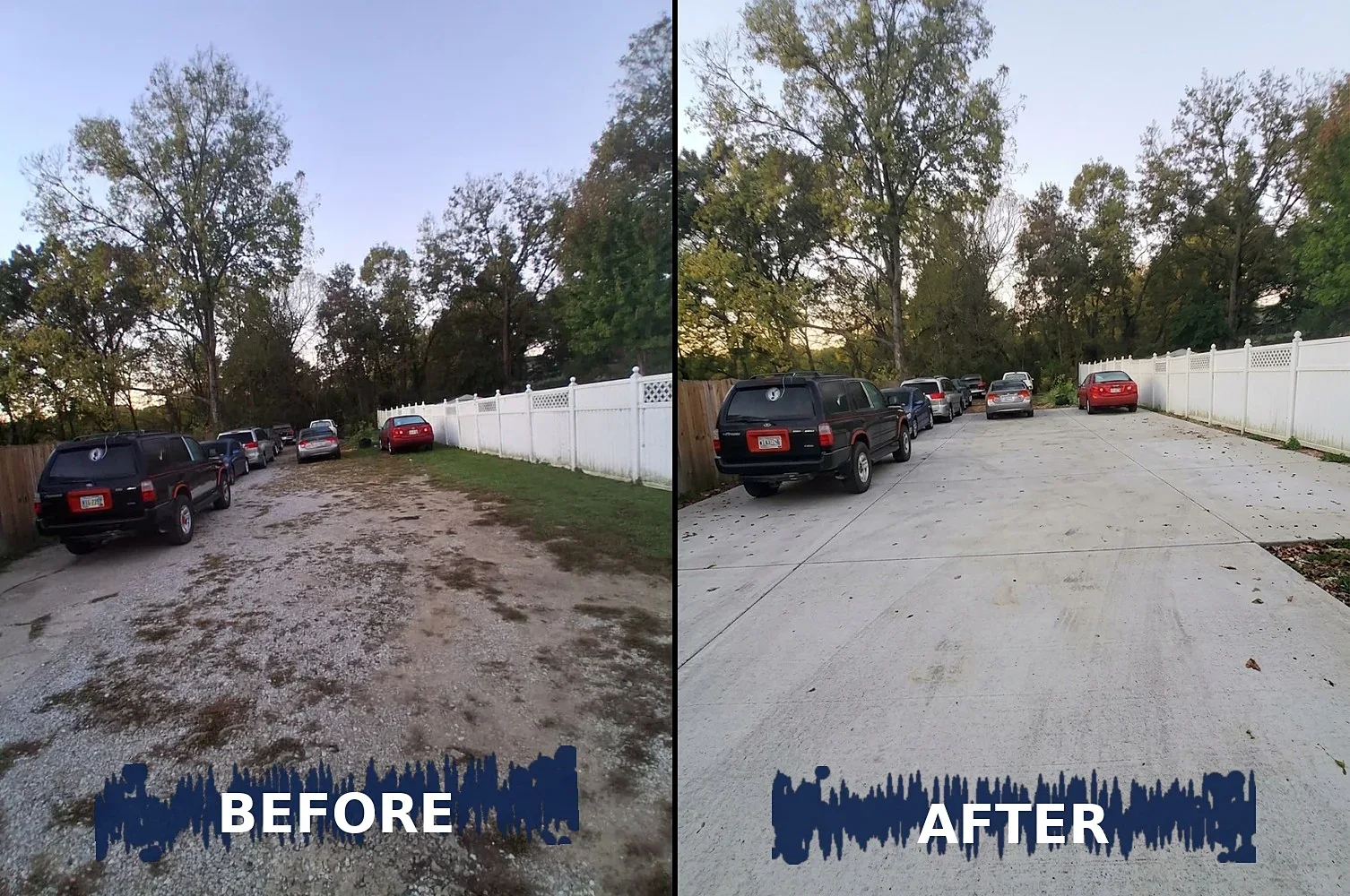
A real job of mine: a gravel driveway (before) replaced with concrete (after). The lines across the new slab are control joints, which give the concrete a planned place to crack. Keep them sealed like any crack. Mark the crack and watch it
Draw a short pencil or crayon line across each end of any crack you could not seal tightly, write the date next to it, and take a photo with a tape measure in the frame. Check again after the next season and after heavy rain. If the crack grows past your marks, gets wider, or one side starts to drop or lift, the cause is still active and it is time for a pro.
Why: Sealing does not fix the reason a slab is moving. ACI's guide notes that if the cause is not corrected, new cracks will probably form. For house foundations, the IRC requires soil investigation where expansive, compressible or shifting soils are likely and special design on expansive soils, which is engineering work, not a caulk job.
Code: ACI 224.1R-07 Section 3.2 (cause not corrected: new cracks likely) · 2024 IRC R401.4 (soil tests where expansive, compressible or shifting soils are likely) · 2024 IRC R403.1.8 (foundations on expansive soils)

A real job of mine: these steps were broken and crumbling (before), well past what sealant or patch can fix, so they were rebuilt (after).
When to stop and call a licensed pro
- One side of the crack is higher than the other and creates a trip edge, or panels are sinking or lifting.
- Cracks run into the house slab, garage floor or stem wall, or you also see doors sticking or cracks in walls, which can point to soil or foundation movement.
- The concrete is crumbling, broken through, or badly spalled over a large area (like the steps above) and needs to be cut out and replaced.
- The crack is in the city sidewalk or the driveway apron at the curb, or the work would change drainage near the house.
- Concrete has to be cut, broken out or poured. New slabs exposed to weather must meet the IRC minimum concrete strength in Table R402.2 for your weathering region, and ACI 224.1R lists structural options such as epoxy injection, which takes special skill.
- You cannot do the grinding or cutting with proper dust control and a respirator.
Common questions
Can I fill a driveway crack with concrete or mortar?
Not if the crack moves. A rigid cement filler usually cracks again next to the repair. ACI's crack-repair guide (ACI 224.1R-07, Section 3.3) says routed cracks should be filled with a sealant such as a urethane or silicone and that cement grouts should be avoided because they are likely to crack. Use a flexible ASTM C920 sealant over backer rod. Rigid patch mixes are for chips and pitted spots; for example, the Quikrete Vinyl Concrete Patcher data sheet says not to use it in cracks under 1/8 inch or in control joints.
Do I need a permit to repair concrete cracks in Phoenix?
Sealing and patching cracks is maintenance. The model 2024 IRC (Section R105.2) lists sidewalks and driveways as exempt from a building permit, but Phoenix does not use IRC Section R105 and writes its own administrative rules. Concrete in the public right-of-way, like the street sidewalk or the driveway apron at the curb, is controlled by the city. Confirm with Phoenix or your own city, and with your HOA, before replacing or adding concrete.
When is the best time to seal concrete cracks in Phoenix?
On a dry day when both the air and the slab are within the product's limits. The example sealant in this guide lists 40 to 100 F for air and concrete, and Sika recommends installing in extreme summer conditions while temperatures are falling. In Phoenix that usually means the cooler months, or early morning in shade during summer, and not right before a monsoon storm.
Why do concrete driveways and patios crack?
Concrete shrinks as it dries and expands and contracts with temperature, so some cracking is normal; control joints are cut in so most of it happens in straight lines. Other causes include soil that settles, swells or washes out, tree roots, heavy vehicles near edges, and missing or too few joints. ACI 224.1R-07 is the industry guide on causes and repair of cracks. If a crack keeps growing or one side drops, the cause is still active.
Is a cracked slab a foundation problem?
A crack in a driveway or patio usually is not. Cracks that continue into the house slab or stem wall, cracks with one side higher, or cracks that come with sticking doors and wall cracks are different and should be looked at by a licensed contractor or a structural engineer. The IRC (Sections R401.4 and R403.1.8) requires soil investigation and special foundation design where expansive or shifting soils are likely.
Want it done right the first time?
I repair, patch and replace concrete driveways, patios, pool decks, walkways and steps across Phoenix. See my Concrete repair in Phoenix, or send a request with the contact form and text me a photo for a fast estimate.
Licensed Phoenix, Arizona General Contractor ROC 367058 (R-62)