How to Replace a Bathroom Sink Faucet (Phoenix Homeowner Guide)
Step-by-step guide to replacing a bathroom sink faucet and drain in a Phoenix home, with the 2024 International Plumbing Code section behind every step: shutoff valves, listed faucet, supply connectors, hot on the left, drain and trap, leak test.
By Gabriel · Licensed Phoenix, Arizona General Contractor ROC 367058 (R-62) · 2026-11-06

A dripping bathroom faucet, a handle that is hard to turn, or a spout crusted white with scale are some of the most common calls I get in Phoenix. Our hard water wears out cartridges and supply lines fast, and replacing the whole faucet is often simpler than chasing parts for an old one.
Below is the order I follow. Every step says why it matters and which 2024 International Plumbing Code (IPC) section it comes from, so you understand the reason and not just the motion.
Tools and parts
- Basin wrench
- Adjustable wrenches (two)
- Channel-lock pliers
- Bucket, towels and a flashlight
- Safety glasses and gloves
- New listed faucet (with its drain assembly, if included)
- Two new listed braided flexible supply connectors sized to the valves and faucet
- Plumber's putty or silicone (per the faucet instructions)
- Thread seal tape (for threaded drain parts only if the instructions call for it)
- Pressure gauge for a hose bibb (optional)
Step-by-step
Check the sink holes and buy a listed faucet
Look under the sink and count the holes in the sink or countertop, and measure center to center (single hole, 4-inch centerset, or 8-inch widespread). Buy a faucet that fits that layout and is marked as meeting ASME A112.18.1/CSA B125.1 and NSF 61. A WaterSense-labeled bathroom faucet is a good choice.
Why: The code requires faucets to meet the ASME/CSA performance standard, and faucets that supply drinking water must meet NSF 61 for lead and contaminant leaching. People brush their teeth and drink from this faucet, so a cheap unlisted import is not worth the risk. The faucet's flow also has to stay under the maximum in Table 604.4 (Phoenix amended this table, so a WaterSense model is the safe pick).
Code: 2024 IPC 412.1 (faucets conform to ASME A112.18.1/CSA B125.1; drinking-water faucets to NSF 61 Section 9) · 2024 IPC 604.4 / Table 604.4 (maximum lavatory flow, Phoenix-amended)
Shut off both valves under the sink and relieve pressure
Turn the hot and cold shutoff valves under the sink clockwise until they stop, then open the faucet to drain the lines. If a valve will not close fully or drips at the stem, shut off the house main and replace that valve with a quarter-turn valve before going further.
Why: The code requires a shutoff valve on the supply to each fixture, and those valves have to stay accessible. In Phoenix, old multi-turn valves often seize with hard-water scale, and the faucet swap is the right time to replace one that fails.
Code: 2024 IPC 606.2 (shutoff valve on each fixture supply) · 2024 IPC 606.3 (access to shutoff valves)
Disconnect the supplies and the drain linkage
Put a bucket under the valves and unscrew the supply connectors from the valves. Unhook the pop-up drain rod from the clevis strap behind the drain (if you have one). Loosen the slip nut on the trap under the tailpiece if you are also replacing the drain.
Why: Old supply lines in Phoenix are often hardened plastic or corroded and should not be reused. Slip joints are only allowed at the trap inlet, trap outlet and within the trap seal, so the tailpiece-to-trap nut is the joint designed to come apart for service.
Code: 2024 IPC 405.9 (slip joints only at the trap inlet, outlet and within the trap seal, with an elastomeric gasket)
Remove the old faucet and clean the deck
Use a basin wrench to remove the mounting nuts under the sink, lift the old faucet out, and scrape off old putty, caulk and scale. Wipe the surface clean and dry.
Why: A new faucet needs a clean, flat surface so its gasket or putty seals. Water that gets under the faucet base runs down into the cabinet and rots the particleboard, which is the hidden damage I see most in Phoenix bathrooms. The code requires joints where fixtures meet surfaces to be watertight.
Code: 2024 IPC 405.6 (watertight joints where fixtures contact walls, floors or counters)
Mount the new faucet per the instructions
Set the faucet with its gasket (or a bead of putty if the instructions call for it), center it, and tighten the mounting nuts from below until it does not turn. Do not over-tighten plastic nuts. If the sink is solid surface or natural stone, check whether the maker says to use silicone instead of putty to avoid staining.
Why: The code requires fixtures and fittings to be installed per the manufacturer's instructions, and a loose faucet rocks every time the handle is used, which loosens the supply joints underneath over time.
Code: 2024 IPC 412.1 (listed fixture fittings) · 2024 IPC 405.6 (watertight joint at the deck)
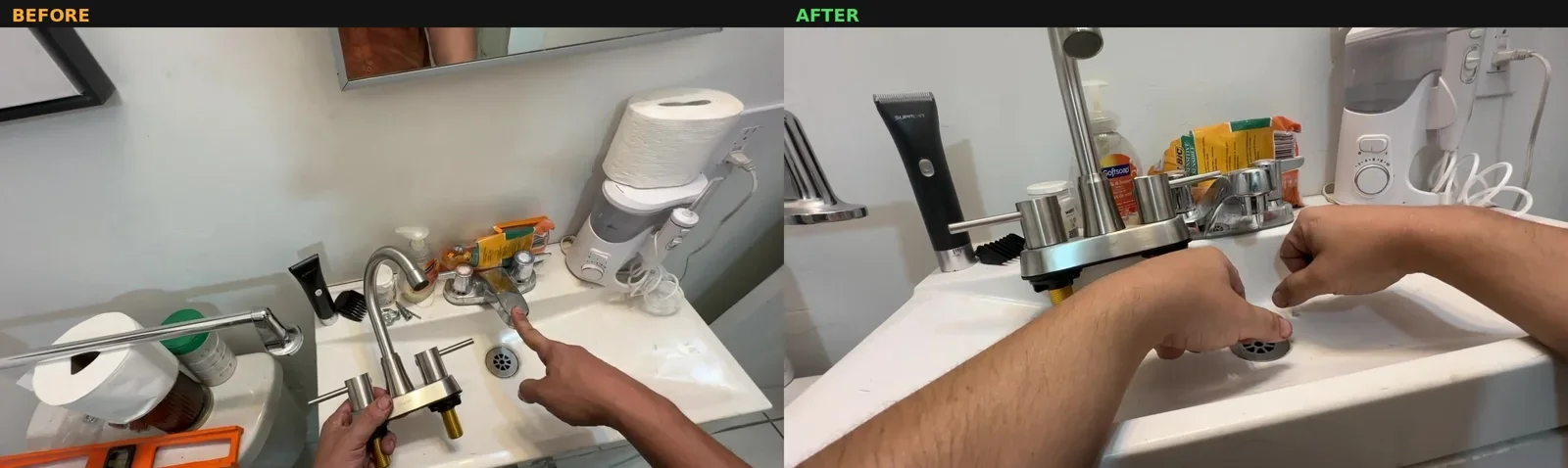
Remove the old faucet, clean the deck, and set the new one square before tightening it down. Install the new drain and set the overflow
If the faucet came with a pop-up drain, install it: putty or gasket under the flange, then tighten the body nut below. Line up the drain's overflow opening with the sink's overflow hole. Connect the pop-up rod to the lift rod.
Why: Bathroom sinks have an overflow, and the code says the overflow must connect on the fixture side of the trap and be designed so water does not sit in it. A misaligned drain body blocks the overflow, and stagnant water in it grows the sour smell many people blame on the drain.
Code: 2024 IPC 405.8 (overflow design) · 2024 IPC 405.8.1 (overflow discharges on the inlet side of the trap)
Reconnect the tailpiece and trap
Trim the tailpiece if needed so the trap lines up without forcing. Use new slip-joint washers, hand-tighten the slip nuts, then snug them a quarter turn. Do not add extra traps or replace the trap with a flexible accordion pipe.
Why: Every fixture needs a trap, and the trap's water seal (2 to 4 inches deep) is what keeps sewer gas out of your bathroom. A trap pulled out of line can lose its seal or leak, and slip joints need their gaskets and must stay where you can reach them.
Code: 2024 IPC 1002.1 (fixture traps required) · 2024 IPC 1002.4 (trap seal not less than 2 in. and not more than 4 in.) · 2024 IPC 405.9 (slip-joint connections with gaskets, accessible)
Connect new braided supply connectors, hot on the left
Install new listed braided connectors from each valve to the faucet. The hot valve goes to the left side of the faucet and cold to the right. Hand-tighten, then snug with a wrench, without twisting or kinking the hoses.
Why: Flexible connectors under continuous pressure must meet their own standard (ASME A112.18.6/CSA B125.6) and must stay accessible. Hot on the left is a code rule so nobody gets scalded by turning the handle the wrong way, which matters in Phoenix summers when even the cold line can run hot.
Code: 2024 IPC 605.6 (flexible water connectors meet ASME A112.18.6 and stay accessible) · 2024 IPC 607.4 (hot water on the left-hand side of the fitting)
Keep the spout above the sink rim
Make sure the spout outlet sits well above the top edge (flood rim) of the sink, as the faucet is designed. Do not add hose extensions or attachments that let the outlet hang down into the bowl.
Why: That vertical air gap between the spout and the sink rim is backflow protection: it keeps dirty sink water from being siphoned back into your drinking water if the pressure drops. The code requires potable outlets to be protected, and the air gap is the simplest method.
Code: 2024 IPC 608.16 (protection of potable water outlets) · 2024 IPC 608.16.1 (air gap to the fixture flood level rim)
Flush the faucet, then check the water pressure
Remove the aerator, open the shutoff valves slowly, and run hot and cold for about a minute to flush out debris, then reinstall the aerator. If you have a hose-bibb gauge, check the static house pressure.
Why: Construction debris and scale clog the new cartridge and aerator. High pressure is a common reason faucets and supply connectors fail early; the code requires a pressure-reducing valve when static pressure is over 80 psi.
Code: 2024 IPC 604.8 (pressure-reducing valve required above 80 psi static)
Leak test and finish
With the faucet on, fill the sink, then pull the stopper and watch every joint with a flashlight and a dry paper towel: valves, connectors, faucet base, drain body, tailpiece and trap. Check again an hour later. Caulk where the faucet or sink meets the counter if the instructions call for it.
Why: Small drips under a sink go unnoticed for weeks and ruin the cabinet floor. The code requires the fixture joints to be watertight, and testing with a full sink puts the drain under the same load it will see in daily use.
Code: 2024 IPC 405.6 (watertight joints) · 2024 IPC 1002.4 (trap seal holds)
When to stop and call a licensed pro
- A shutoff valve is seized or leaks, or the pipe behind it is old galvanized steel that may snap.
- The cabinet floor is soft, stained or moldy (water has likely been leaking for a while).
- The sink or countertop is cracked, or the new faucet needs new holes drilled in stone.
- The drain is slow or gurgles after the swap, or the trap arm in the wall is loose or corroded.
- Your house pressure reads over 80 psi or the pressure-reducing valve needs replacement.
- You are moving the sink or adding one (new supply, drain and vent work usually needs a permit; check with your city).
Common questions
Do I need a permit to replace a bathroom faucet in Phoenix?
A same-location faucet swap is usually treated as a repair, but rules differ by city and by job. Moving the sink, adding a fixture or changing the drain is new plumbing work, so check with your city's development services before you start if you are changing anything beyond the faucet.
Can I reuse my old supply lines?
I don't. Old lines are often hardened or corroded, and new listed braided connectors are inexpensive. The 2024 IPC (605.6) requires flexible connectors under constant pressure to meet ASME A112.18.6 and to stay accessible.
Why is my new faucet's flow so weak?
In my experience it is usually debris or hard-water scale in the aerator or cartridge, or a shutoff valve that is not fully open. Remove and rinse the aerator, and make sure both valves are all the way open.
Which side does hot water go on?
The left. The 2024 IPC (607.4) requires faucets to be installed so hot water corresponds to the left-hand side of the fitting.
Plumber's putty or silicone?
Follow the faucet and sink maker's instructions. Many faucets come with a gasket and need neither, and some stone and solid-surface makers ask for silicone because putty can stain.
Want it done right the first time?
I replace bathroom and kitchen faucets, sinks, vanities, supply lines and shutoff valves across Phoenix. See my Faucet and sink installation in Phoenix, or send a request with the contact form and text me a photo for a fast estimate.
Licensed Phoenix, Arizona General Contractor ROC 367058 (R-62)