How to Replace an Outdoor Outlet With a Weatherproof GFCI (Phoenix Homeowner Guide)
Step-by-step guide to replacing an outdoor outlet in a Phoenix home with a weather-resistant GFCI and an extra-duty in-use cover, with the NEC 2023 section behind every step.
By Gabriel · Licensed Phoenix, Arizona General Contractor ROC 367058 (R-62) · 2026-11-22
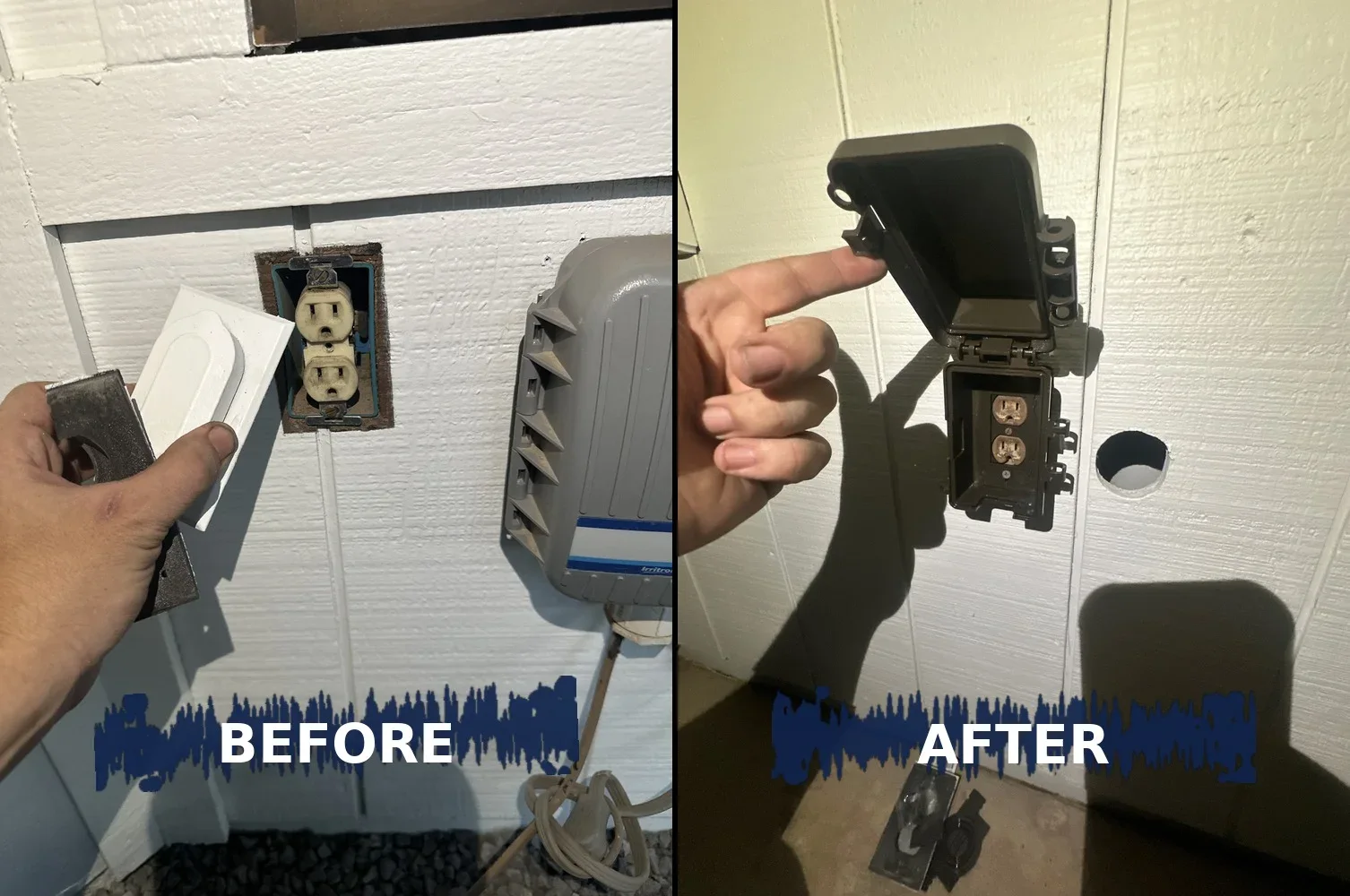
Outdoor outlets in Phoenix live a hard life. The sun bakes the plastic covers until they crack, monsoon storms push wind-driven rain and dust into every gap, and sprinklers soak the wall below. When I get a call about a dead patio outlet, a GFCI that trips every time it rains, or a cover that blew off, the fix is usually the same: replace the device with a listed weather-resistant GFCI receptacle and put an extra-duty in-use cover over it so it stays dry even with a cord plugged in.
Below is the order I follow to replace an existing outdoor receptacle on a house. Every step says why it matters and which section of the 2023 National Electrical Code (NEC) is behind it. This guide is for replacing an outlet that is already there. Adding a new outdoor outlet or running a new circuit is a different job that usually needs a permit, so read the call-a-pro section first. For indoor outlets, see my guide on how to replace an electrical outlet; for switches, see how to replace a light switch.
Tools and parts
- Non-contact voltage tester and a multimeter (with a known live outlet to check them on)
- Plug-in receptacle tester with a GFCI test button
- Insulated screwdrivers and a torque screwdriver
- Wire stripper and needle-nose pliers
- Listed weather-resistant (WR) GFCI receptacle, 15 A or 20 A to match the circuit (usually also tamper-resistant, TR)
- Listed extra-duty in-use (bubble) cover sized for the box and the GFCI, with its gasket
- Green grounding screw and a short bare or green pigtail (for metal boxes)
- Exterior-grade sealant recommended by the cover or box maker
- Painter's tape and a marker to label the breaker
Step-by-step
Decide whether the outlet is in a damp or a wet location
Look at where the outlet sits. Under a roofed patio or deep porch where rain does not beat on it, it is a damp location. On an open wall, a block wall, near sprinklers or anywhere rain and runoff can hit it, it is a wet location. Most outdoor outlets on Phoenix houses (back walls, side yards, garage exteriors, pool equipment areas) are wet locations.
Why: The location decides the cover. A damp location needs a cover that is weatherproof with nothing plugged in. A wet location needs a cover that stays weatherproof while a cord is plugged in, because people leave holiday lights, pumps and chargers plugged in for weeks. If you are not sure, treat it as wet: the in-use cover works in both.
Code: NEC 2023 406.9(A) (damp locations) · NEC 2023 406.9(B)(1) (15 A and 20 A receptacles in wet locations)
Turn off the breaker and label it
Find the breaker that feeds the outlet. Outdoor outlets are often on a garage or bathroom circuit, so plug a radio or work light into the outlet and switch breakers off until it goes quiet. If the outlet is fed through a GFCI somewhere else, press its RESET first so you can see power. Put tape over the breaker and write "working, do not turn on" on it, and fix the panel label if it was wrong.
Why: You need to know exactly which breaker kills this outlet, and other people in the house need to know not to turn it back on. A wrong or missing panel label is also how the next person gets surprised.
Code: NEC 2023 408.4(A) (every circuit legibly identified in the circuit directory)
Prove the outlet is dead with two testers
Check your non-contact tester and multimeter on a known live outlet first. Then test both halves of the outdoor outlet, and after you remove the cover, test every wire in the box: hot to neutral, hot to ground and neutral to ground. Finally, check the testers again on the known live outlet.
Why: Testers fail, batteries die, and outdoor boxes sometimes have a second circuit in them. Testing the tester before and after (live-dead-live) is the only way to be sure a "dead" reading is real and not a broken meter.
Code: NFPA 70E-2024 120.6(7) (test for absence of voltage; verify the tester on a known source before and after)
Remove the old outlet and inspect the box and wires
Take off the old cover and pull the receptacle out without pulling on the wires. Note which wire goes to which terminal; take a photo. Look for: a green or bare ground wire (or a metal conduit system), corrosion, rust or water stains in the box, brittle or sun-cracked insulation, scorch marks, and wires labeled AL (aluminum). If more than one cable is connected, note which pair was on which set of screws.
Why: Outdoor boxes fail from water and heat long before indoor ones do. Insulation or a box damaged by sun or water is not identified for that environment anymore and has to be fixed, not just covered up. Whether you have a ground decides which replacement options you are allowed to use.
Code: NEC 2023 110.11 (deteriorating agents: wet locations, heat) · NEC 2023 406.4(D)(1) (grounding-type replacement where a ground exists) · NEC 2023 406.4(D)(2) (options where no ground exists)
Buy the right replacement: a listed weather-resistant GFCI
Buy a GFCI receptacle marked WR (weather-resistant), with the same amp rating as the circuit (15 A on a 15 A breaker, 15 A or 20 A on a 20 A breaker). Most WR GFCIs for homes are also TR (tamper-resistant). Check the box says it is listed (UL, ETL or CSA mark).
Why: Outdoor receptacles at a house have to be GFCI protected, and when you replace one at a location that requires GFCI, the replacement has to give GFCI protection too. WR receptacles have materials and shutters made to handle moisture, UV and corrosion, and they are required for replacements in damp and wet locations. Dwelling receptacles also generally have to be tamper-resistant to keep kids from pushing objects into the slots.
Code: NEC 2023 210.8(A)(3) (GFCI for dwelling receptacles outdoors) · NEC 2023 406.4(D)(3) (GFCI required at replacements; GFCIs listed) · NEC 2023 406.4(D)(6) (weather-resistant replacements) · NEC 2023 406.9(B)(1) (nonlocking 15 A and 20 A receptacles in wet locations listed weather-resistant) · NEC 2023 406.4(D)(5) and 406.12 (tamper-resistant)
Check whether a GFCI upstream already protects it
Some outdoor outlets are already protected by a GFCI in the garage or bathroom, or by a GFCI breaker. If pressing TEST on another GFCI killed this outlet in step 2, it is downstream. You can still put a GFCI here, but many people prefer one outside so it can be reset without walking to the garage. Either way, the GFCI that protects the outlet must be somewhere you can reach easily, not behind a fridge or in the attic.
Why: If nobody can find the GFCI that tripped, the outlet just looks dead and people start using extension cords from inside. The code requires GFCI and AFCI devices to be in readily accessible places so they can be tested and reset.
Code: NEC 2023 210.8 (GFCI device in a readily accessible location) · NEC 2023 406.4(D) (replacement GFCI and AFCI receptacles readily accessible)
Make sure the box is listed for wet locations and big enough
GFCIs are deeper than regular outlets. Make sure the box is solid, not cracked or rusted through, and listed for wet locations, and that the GFCI and all the wires will fit without being crushed. A shallow box often needs an extension ring or a deeper weatherproof box. If the box is loose in stucco or block, it has to be fastened back securely before the new device goes in.
Why: A cracked or non-wet-rated box lets water sit on the terminals, which is what makes GFCIs trip in the rain and terminals corrode. A crammed box damages insulation and loosens connections. If the outlet box truly will not fit a GFCI, the code allows a regular WR receptacle fed by a GFCI elsewhere, marked "GFCI Protected" (and "No Equipment Ground" where there is no ground).
Code: NEC 2023 314.15 (boxes in wet locations listed for wet locations; prevent moisture accumulation) · NEC 2023 314.16 (box fill) · NEC 2023 406.4(D)(3) Exception (box too small for a GFCI)
Connect hot and neutral to the LINE terminals
Strip about 5/8 in of insulation (use the strip gauge on the GFCI). Connect the incoming hot (black) to the brass LINE screw and the incoming neutral (white) to the silver LINE screw. Leave the yellow tape on the LOAD terminals unless you deliberately want this GFCI to protect outlets downstream; in that case the outgoing pair goes on LOAD. If you are not sure which cable is incoming, stop and test again with power on carefully, or call a pro.
Why: A GFCI wired backward (feed on LOAD) can leave the receptacle face powered with no protection, and most new GFCIs will refuse to reset if wired backward. Following the instructions that come with the listed device is part of the code, not just a suggestion.
Code: NEC 2023 110.3(B) (install listed equipment per its instructions) · NEC 2023 406.4(D)(3) (listed GFCI protection)
Connect the ground so it never depends on the outlet
Connect the bare or green equipment ground to the GFCI's green screw. If the box is metal, the grounds also have to be connected to the box with a green screw or listed clip, using a pigtail so the box stays grounded even when the receptacle is removed. If there is no ground at all, a GFCI is still allowed, but it must be marked "No Equipment Ground" (the sticker comes in the box).
Why: The ground is the path that trips the breaker if a hot wire touches a metal box or cover. If it depends on the receptacle staying in place, taking the outlet off would leave the metal box ungrounded and dangerous.
Code: NEC 2023 250.148 (equipment grounding conductors connected in boxes) · NEC 2023 250.148(B) (removing a device must not interrupt grounding continuity) · NEC 2023 406.4(D)(2)(b) (GFCI with no ground marked "No Equipment Ground")

Tighten every terminal to the specified torque
Check the torque value printed on the GFCI or its instructions (often in inch-pounds) and tighten each terminal screw with a torque screwdriver. Tug each wire gently afterwards.
Why: Loose terminals are a top cause of heat and burned outlets, and outdoors the daily heat cycles in Phoenix loosen screws even faster. Over-tightening can crush the wire or crack the device. When a torque value is marked, the code requires an approved means, like a torque tool, to reach it.
Code: NEC 2023 110.14(D) (terminal connection torque) · NEC 2023 110.3(B) (follow listing instructions)
Mount the GFCI and install the extra-duty in-use cover
Fold the wires neatly into the box and screw the GFCI tight to the box so it does not move when a plug is pulled out. Install the in-use cover with its gasket, following its instructions (some covers ship with adapter plates for GFCI openings). Make sure the hinged lid can open at least 90 degrees after it is installed and that the cord exits from the bottom. Seal around the box or mounting plate only as the cover or box maker says; many instructions leave the bottom unsealed so water can drain.
Why: A loose receptacle wiggles its wires loose over time. In a wet location the cover has to keep water out while a cord is plugged in, and in-use hoods have to be listed and identified "extra-duty" so they survive sun, wind and kids. A lid that cannot open fully ends up forced open or broken. Water that gets in has to be able to get out instead of pooling on the GFCI.
Code: NEC 2023 406.5 (receptacle mounting) · NEC 2023 406.9(B)(1) (weatherproof with a plug inserted; outlet box hood listed and identified extra-duty; hinged cover opens at least 90 degrees) · NEC 2023 314.15 (prevent moisture entering or accumulating in boxes)
Restore power and test the GFCI
Remove your tape, turn the breaker on, and press RESET. Plug in a receptacle tester: it should show correct wiring. Press the GFCI's TEST button (power should cut off), then RESET. Use the tester's GFCI button too. Close the in-use cover. Test the GFCI monthly, and after any monsoon storm if the outlet was hit by water.
Why: The tests prove the wiring is correct and that the GFCI actually trips. Following the manufacturer's test instructions is part of installing a listed device, and a GFCI that does not trip is no protection at all.
Code: NEC 2023 110.3(B) (follow listing and test instructions)

When to stop and call a licensed pro
- You want a new outdoor outlet where there is none, or you need to run a new circuit, conduit or underground wiring. That is new work, usually needs a permit, and requires its own GFCI, box and wiring method.
- The outlet feeds pool, spa, fountain or pond equipment. Those have their own special code rules.
- The GFCI keeps tripping after replacement, or trips every time it rains: that usually means water in a box, a damaged cable or a fault in something downstream.
- You find aluminum wiring, melted or scorched insulation, sun-cracked cables, rusted-through boxes, or a box with more than one circuit you cannot sort out.
- There is no ground and you want a real equipment ground added, or the outlet is on a 240 V or larger circuit.
- The wall is stucco or block and the box has to be replaced or re-set in the masonry.
Common questions
Do outdoor outlets have to be GFCI in Phoenix?
Yes. Under the 2023 NEC, which Phoenix uses through the 2024 PBCC, receptacles outdoors at a dwelling need GFCI protection (210.8(A)(3)), and when you replace one, the replacement has to be GFCI protected too (406.4(D)(3)). The protection can come from a GFCI receptacle at the outlet, a GFCI upstream, or a GFCI breaker. Other cities may adopt different editions, so check yours.
What is the difference between a WR and a regular GFCI?
A WR (weather-resistant) receptacle is built and listed to handle moisture, UV and corrosion better than an indoor device. The 2023 NEC requires listed weather-resistant receptacles in damp and wet locations (406.9), including when you replace one (406.4(D)(6)). Look for the WR marking on the face of the device.
Why does my outdoor GFCI trip when it rains?
Usually water is getting into the box or a plugged-in cord, light string or connection, or a cover is cracked or not an in-use type. Moisture creates a small current leak and the GFCI does its job. Dry everything, replace damaged covers, gaskets and cords, and if it keeps happening have the box and wiring checked.
Do I need a bubble cover or is a flat cover enough?
In a wet location, the receptacle has to be weatherproof while something is plugged in, so you need an in-use (bubble) cover, and the hood must be listed and identified extra-duty (406.9(B)(1)). A flat flip-lid cover is only weatherproof when nothing is plugged in, which is acceptable in a damp location under a roof (406.9(A)).
Can I put a GFCI on an outdoor outlet that has no ground wire?
Yes. The code allows a GFCI receptacle where no equipment ground exists, as long as it is marked "No Equipment Ground" (406.4(D)(2)(b)). The GFCI still protects people from shock, but it does not create a ground for equipment that needs one.
Do I need a permit to replace an outdoor outlet?
Rules differ by city, and Phoenix, Scottsdale, Mesa and the county each set their own permit requirements. A like-for-like replacement is very different from adding a new outlet or circuit, which generally needs a permit. Check with your building department before you start if you are not sure.
Want it done right the first time?
I replace outdoor outlets, GFCIs and weatherproof covers across Phoenix, and I can add a new outdoor outlet or circuit when you need one. See my outlet and switch installation service in Phoenix, or send a request with the contact form and text me a photo for a fast estimate.
Licensed Phoenix, Arizona General Contractor ROC 367058 (R-62)